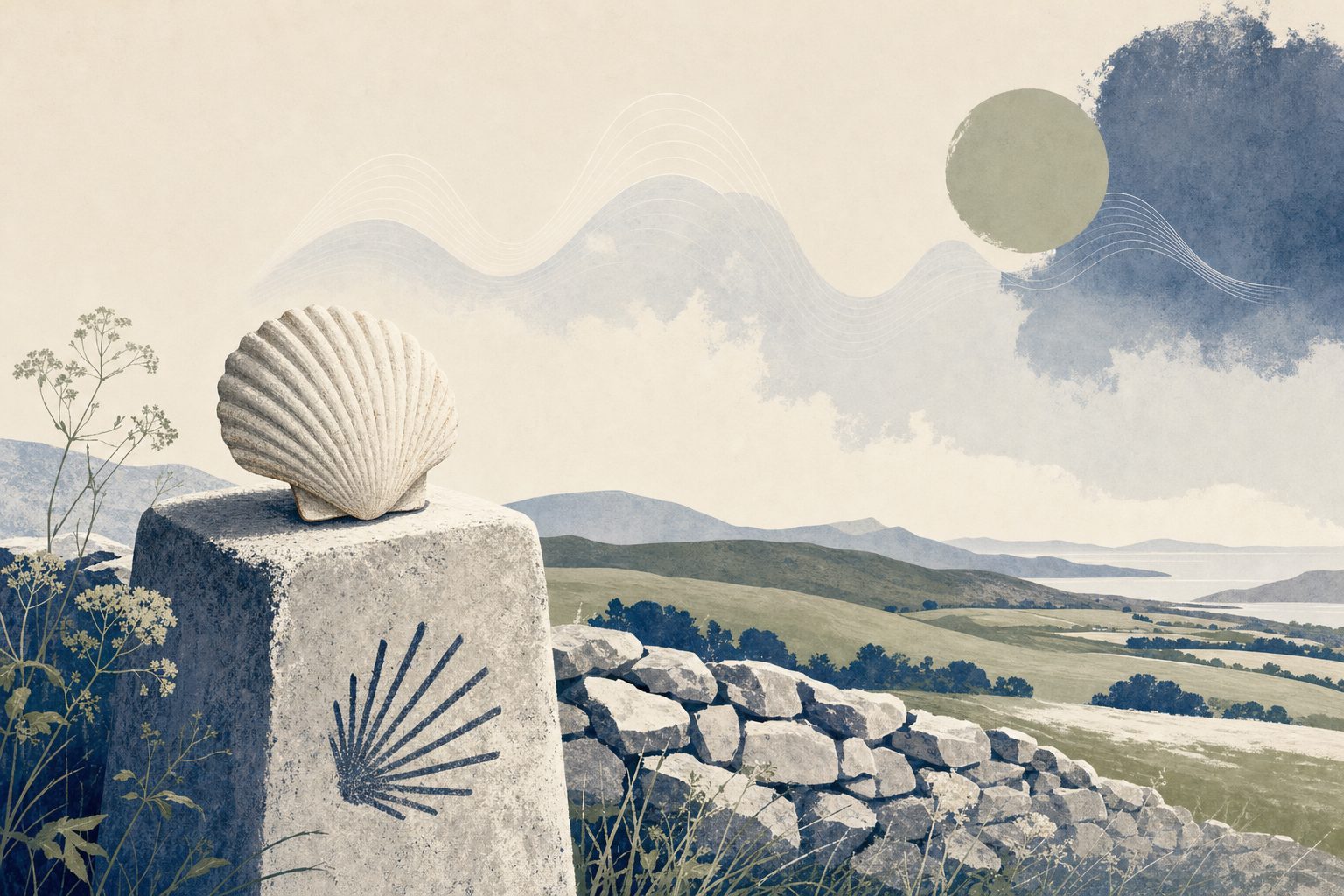
Can a long walk help a person recover?
In March 2019, I spoke with Milly Day, who was part of the small team behind Recovery Trekking. The idea was to guide people in recovery along the Camino de Santiago, the old pilgrimage route in Spain, as a way of healing the mind and body. Milly is in recovery herself, and she was living in England when we talked.
This is an archive episode, recorded when the show covered addiction and recovery broadly. We talked about nature, spirituality, travel, medication, and what a person can do when the same approach keeps failing.
How did the idea for the trek begin?
At 1:08, Milly explained that she did not create the company. It was founded by a woman named Sparrow and her business partner, Peter, who are both in recovery. Milly joined because the project combined nature, hiking, and helping people.
From 2:06, she described the route itself. In her view, a pilgrimage is not only for religious people, since it also has a spiritual side. Sparrow had walked it herself, found it deeply therapeutic, and wanted to take others along as an alternative to a residential program.
At 3:11, Milly described two options. A shorter trek of about a week was meant for people who were already sober and wanted to go deeper. A longer one of about a month was meant for people who were still struggling, including those for whom more traditional approaches had not worked.
Why might physical activity matter so much?
At 3:54, I mentioned a previous guest who had been through a program in California built around rowing, running, and team building. I said that physical activity may be especially important for people coming off opioids. The body’s own endorphin system has been hijacked, and hard physical effort may help to reset it.
Milly agreed at 4:56, and added that the setting matters as much as the exercise. She had walked a different pilgrimage in Italy with her partner, and she described herself as an anxious person who is easily overwhelmed. Interestingly, the strongest effect she noticed was how calm she became.
In her view, the trail strips life down to eating, hiking, sleeping, and washing. Away from traffic, noise, and the pace of a city, that simple routine calmed her down.
Does spirituality have to mean religion?
At 7:39, I shared what I try to tell people who are just getting started. Recovery can actually be a lot of fun. I also said that people should not be afraid of spirituality, even when they hear someone else’s name for God, and I offered a theory that addiction cannot quite reach the spiritual part of the brain.
At 9:02, Milly said that many of the people who walk these routes are not religious. They are often at a turning point, such as a serious diagnosis, a divorce, or the loss of a job, and they are looking for a spiritual answer rather than a religious one. Of course, she admitted that the word God once frightened her too. Over time it became familiar.
Can a person stay sober while traveling?
At 10:32, Milly called herself one of the biggest advocates of having fun in recovery. She does not believe people get sober to live a dull life. Since getting sober, she had lived in Berlin and worked in Southeast Asia.
She was candid about what that cost her. At 13:40, she said that meetings were much harder to find there, and that she went to very few during those months, which she would not advise anyone to copy. Fortunately, she later discovered online meetings as a backup wherever there is a good internet connection. At 14:51, she said that every trek group would hold a meeting each day.
What about families, and people who would rather stay closer to home?
At 16:49, I described a former guest who is deeply involved in Nar-Anon, a support group for the families and loved ones of people who use drugs. At 17:45, Milly said that one of their programs was designed specifically for families.
From 18:07, she said that many Americans are apprehensive about leaving the country, getting visas, or applying for passports. So, the team was looking at a trek along the Chesapeake and Ohio Canal Trail.
Can someone taking medication for opioid dependence join a trek?
At 21:56, I raised a question the team had not yet considered. Methadone would make a trip like this almost impossible, because people must visit a clinic every day for their dose. Buprenorphine is different, because a person who is doing well can be prescribed a month at a time, and naltrexone is not a controlled medication at all.
Milly said at 23:12 that she saw no reason it would be a problem. At 23:36, I added a second concern. Narcotics Anonymous (NA) has an official position that a person taking Suboxone is not clean, and someone in the first few months on medication can be fragile if people try to coax them off it.
At 24:36, Milly said that she would never want anyone to be vilified for taking a medication that helps them. In the meetings she attends, people on these medications describe themselves as clean and sober, and she had never seen anyone challenge them.
Where do harm reduction and naloxone fit in?
At 26:15, I described what an ideal safe injection site could offer a person who cannot stop using. They could have their drugs tested for fentanyl, get clean needles, and learn what help is available. Milly said at 27:02 that she had heard Portugal has such sites, and that turning a blind eye helps no one.
At 27:35, I suggested keeping naloxone, also sold as Narcan, on hand during the treks, just in case. In fact, I said it may soon need to be available everywhere. At 28:16, I described a billboard on a highway in Maryland that counts overdose deaths, and I said that much of the danger came from heroin being poisoned by fentanyl analogs.
Why does leaving a familiar environment help?
At 29:12, I talked about how hard it is to stay away from cocaine when you still live in the same neighborhood. A person six months into recovery can find themselves driving down the old street without thinking. Getting out of that setting completely, and spending time with other people in recovery, could make a real difference.
Milly agreed at 30:39. She said that the only thing anyone would be exposed to on the Camino is wine and other alcohol, and that there would be no other drugs. Unfortunately, in Berlin she saw drug use in train stations and on the streets, and she said a trek would take people away from that.
What if the same approach keeps failing?
At 33:22, I repeated a saying people often hear in recovery: insanity is doing the same thing over and over and expecting a different result. I also recalled the guest from California, who had been through program after program in Florida before he tried something different.
At 34:12, Milly said that she and both founders know people who have gone back to residential programs again and again without lasting change. At 36:36, she said she knows people who walked the Camino on their own while they were at their lowest, and that it changed things for them. Yet, she was careful to say that she had never been to rehab herself.
Who is Milly Day?
Milly Day is a member of the Recovery Trekking team, where she handled online outreach and planned to lead the women’s groups. She studied French and Italian at university, has lived in South America and Germany, and has been sober for a few years.
What can listeners take away from this conversation?
Milly’s message was that recovery does not have to be small or dull, and that time outdoors with other people can calm a mind that never seems to settle. However, the conversation also showed how much planning a program like this needs, from daily support to room for people who take medication for opioid dependence.
How do I approach this today?
My thinking has kept developing since this conversation was recorded. Today my practice is built on one idea that runs through all of it: when the body has adapted to a substance, the safest way off is usually gradual, with the smallest steps the person’s nervous system can tolerate. Physical dependence is not addiction.
For opioid dependence I prescribe buprenorphine, which steadies the body so a person can rebuild their life without the cycle of withdrawal. Visits are monthly, or weekly when needed. Some people stay on it for a long time, and that is a legitimate choice. Others later taper slowly, using the same gradual approach I use for every other medication.
I believe medication for opioid dependence should be available wherever people need it. I prescribe in Florida only.
Call 911 or go to an emergency department if there is a seizure, confusion or hallucinations, or thoughts of self-harm. For thoughts of suicide or any mental health crisis, you can also call or text the 988 Suicide and Crisis Lifeline.
This page is educational. It is not medical advice, and listening to the episode or reading this page does not create a doctor-patient relationship. Decisions about starting, continuing, or tapering any medication should be made with your own physician.
Full transcript
A note from Dr. Leeds: my guests speak from their own experience and expertise, and the terminology they use is their own. Whatever the topic, this show holds to one distinction: physical dependence on a prescribed medication is not addiction. This transcript is educational content, not medical advice, and nothing here creates a doctor-patient relationship.
Read the full transcript (39 minutes)
Dr. Mark Leeds [00:09] Welcome to The Rehab on the Mental Health News Radio Network. I am Dr. Mark Leeds and I will be your host. Join me in exploring the world of addiction treatment. How can we improve the ways that we help individuals to overcome addiction? The goal of treatment is to save lives and help people to get back on track to a path towards success and happiness in life. My guest on the Rehab Podcast is Milly Day of Recovery Trekking. In a nutshell, Recovery Trekking is a brand new recovery platform, both for addicts stuck in active addiction and for those who have already begun their journey, whereby you’re guided along an ancient pilgrimage route as a form of healing for the mind, body and soul. Is Recovery Trekking, is that your company?
Milly Day [01:08] I didn’t create the company. It was created by a woman named Sparrow and her business partner, Peter, who are both in recovery as well. And I met Sparrow in the south of France, not last summer, but the summer before. And it was interesting because we only met the one time, but we obviously clicked. We had a connection and yeah, she ended up calling me several months later to ask me if I’d like to be involved in a new project of hers. And that project is recovery trekking. And I said yes, because it sounded like everything that, you know, that appeals to me. You know, it’s nature, it’s hiking, it’s helping people, it’s helping people in recovery more specifically. And so I just I just jumped at the opportunity, really. So, yes, now it’s just a small team of us, Sparrow, Peter and myself. All operating from different parts of the world. Sparrow is in France. Peter is in Maryland. I’m here in the UK.
Dr. Mark Leeds [02:02] So with Recovery Trekking, the three of you would be together with a group?
Milly Day [02:06] Yeah, so we’re thinking further down the line that we’ll have male and female groups. So I’d be leading the women and Peter would be leading the men. But at the moment, we’re kind of all doing everything. I’m doing the sort of social media and marketing, well, the sort of online marketing. Peter and Sparrow doing the more hands-on marketing and the Camino de Santiago which is the trek that we’d be going along is you know it’s this renowned pilgrimage route it’s very old, it’s very traditional it’s not just for religious people because I think when people hear the word pilgrimage they associate it with religion obviously a lot of religious people do it but it’s also got a spiritual element you know Sparrow did the trek herself and she found it to be very therapeutic and she just had the idea of you know of taking other addicts and alcoholics along the trek as a kind of as a form of therapy really as an alternative to rehab
Dr. Mark Leeds [03:01] I was reading the website I see that it’s mostly intended for people who have clean time and are time sober and are interested in going deeper into their recovery
Milly Day [03:11] There are actually two different programs that we offer so there is one for people who want to go who have been clean and sober for a while and you want to go deeper into their recovery that is the Adventures in Recovery program and that’s just a week or so but then we’ve also got Rehab Reimagined which is for people who are struggling to get clean and sober perhaps they don’t believe in a higher power perhaps they’ve tried rehab they’ve tried other sort of more traditional methods and it’s just not working for them that is for people who are not yet clean and sober but you know who desperately need the treatment and so that’s a longer program that would be more like a month long. So there are the two programs. So yeah, basically, whether you’re clean, sober or not, there’s an option for you.
Dr. Mark Leeds [03:54] Rehab Reimagined, it sounds like a great idea. I mean, there was a, I had a previous guest on the podcast where he had been through a program in California, and it was a little bit different than most rehab programs where usually, you know, people go and they kind of sit around all day and go to group meetings and get therapy. And this other program in California, it’s run by a retired Navy SEAL. And it’s very, they’re very much heavily involved in physical activity. They go rowing and running and there’s team building and they get to know the people very well that they’re with. But the primary difference between most other programs is that team building and the physical activity. And the physical activity, I think, is really important, especially for people now dealing with opioid addiction. And they’re kind of, their natural, you know, the natural system for opioids, the endorphin system has kind of been hijacked by drugs and, you know, maybe needs to be reset by really getting heavily into physical activity.
Milly Day [04:56] Yeah, I completely agree. And, you know, not just it’s not just physical activity that’s beneficial, it’s physical activity in the nature. You know, I’ve also experienced this because I did a pilgrimage myself. It was actually a different one. It was in Italy. It’s called the Camino di Francesco but and it was a bit shorter it was two and a half weeks or yeah it can take you longer but it took me and my partner two and a half weeks and you know I’m quite an anxious person I get anxious and stressed quite easily I get very very easily overwhelmed I’m sure these are very typical traits of an addict but just walking every day and I mean it was intensive because we were doing you know roughly 30 kilometers a day which isn’t what we’d expect other people to do but we were trying to, you know, do it as quickly as possible. And just doing that amount of exercise every day in the nature was incredible. I think for me, the most profound effect was how much it calmed me down. By the end of it, I was just incredibly calm. And I guess it’s because you don’t have to think or worry about anything besides getting from A to B. And you sort of revert to the most simple, basic lifestyle. You’re eating, you’re hiking, you’re sleeping, you’re washing. And then And when we take other people along these treks, we’ll be doing some meditation. We’ll be doing some step work as well. But it’s basically a very, very simple life. And I think that’s what helped calm me so much. And the fact that you’re just away from the city, you’re away from traffic and noise and the kind of hectic vibe of the city. I just think it just has a really, really calming effect, or at least it did on me.
Dr. Mark Leeds [06:32] Getting back to nature, it sounds like a really great idea. And there are a lot of retreat programs where, you know, in AA and NA where they’ll go once a year on a retreat. Like, for example, here, I know they have a retreat where they go, I think, to the Keys and camp out in nature for a few days and have meetings. And it’s a very spiritual kind of a program. And, you know, so this sounds like taking that up to a higher level where you’re not just going a few hours south of where you live, but to a whole other country. And you’re taking an actual spiritual pilgrimage.
Milly Day [07:07] Yeah, exactly. So I guess, yeah, I guess it is similar to the retreats, but we incorporate, you know, various different things. We’d also have meetings. The one difference would be that we don’t camp. I mean, I’d be happy to camp, but I know not everybody enjoys camping and we’d have, you know, sort of sturdier accommodation and that way people don’t have to carry tents and things because also it’s obviously quite, So it’s definitely a challenge carrying your own tent and carrying your own camping equipment. But yeah, it’ll be very similar to that kind of thing.
Dr. Mark Leeds [07:39] And one thing, you know, and I have a medical practice where I take care of people just getting started in recovery. And it’s, you know, and what’s available locally. And it’s kind of a difficult thing to tell people. You know, you can really have a lot of fun in recovery. It’s actually a lot better than going back to drinking or using drugs. But, you know, sometimes, you know, people ask, you know, what are we going to be able to do? And I’m like, well, they have baseball games on Sunday, you know, or, you know, picnics and barbecues and that kind of thing. But I mean, this and another thing is that I try to tell my patients that you shouldn’t be afraid of spiritual programs and spirituality. Not in fact, that getting involved in spiritual activities is really a good way to fight addiction. It seems like addiction and alcoholism can’t really get to that part of the brain that’s spiritual. And, you know, people shouldn’t be afraid of in a meeting if they talk about God or even if a Christian program, if a person is not Christian, it’s not going to kill a person to hear someone else’s name for God. Or, you know, not that they should heavily have to go fully into another religion or anything like that. But you know on the pilgrimage you’re talking about if a person happens to not be a christian there’s really there shouldn’t be anything to be afraid about I mean it sounds like a deeply spiritual experience
Milly Day [09:02] Yeah it is indeed and you know a lot of the people like I said before a lot of the people who do these pilgrimages aren’t religious you know they’re doing it for other reasons you know you tend to meet a lot of people who have come to a turning point in their lives so not necessarily you know discovering they have an addiction but perhaps discovering they have a fatal illness or you know divorcing their husband or their wife or losing their job and you meet some very you know interesting people with very inspiring stories and they’re seeking a spiritual solution you know it’s the same for everyone they’re seeking a spiritual solution rather than a religious one I mean yeah a lot of people do do it for religious purposes but I think you almost meet more people who are doing it for other reasons and I think the reason that many people are so kind of freaked out by the God word is because it’s unfamiliar. It’s unknown. It’s kind of alien to a lot of people. Not to everyone, of course, but, you know, I think I was probably the same when I first came into recovery. That word scared me a bit. And now I say it just rolls off the tongue. It’s a bit like saying I’m Milly and I’m an alcoholic. You know, it totally freaked me out to say that to begin with because it was just so alien. And now it’s not. Now it’s fine and I completely embrace that and I also embrace the God word
Dr. Mark Leeds [10:13] In your situation you’ve been sober for a few years now and I believe you told me that you would early on done some traveling on your own and not part of this program specifically but you would just rather than staying in one place where are you from originally are you originally from England yeah
Milly Day [10:32] I am originally from England and yeah I have done quite a bit of traveling and I’ve also lived in a few other countries. And, you know, a bit like what you were saying before about having fun and recovery, you know, I’m possibly the biggest advocate of having fun and recovery and living your life, because I don’t believe we get sober and clean to live a dull life. So I really cram it in, you know, I love to travel, I love to explore, I’m a real explorer. I love to meet people, you know, see new countries and, you know, discover new things. And I just, yeah, I wouldn’t ever want to let, you know, not drinking and not using get in the way of that. So, yeah, prior to I was actually living in Berlin up until quite recently. I moved home end of August, beginning of September. I also spent six months in Southeast Asia. That was actually for a job, which is why it was just six months as a six month placement. Yeah. Where else do I live? Well, I lived in other places prior to getting sober. That’s what I’ve done since getting sober.
Dr. Mark Leeds [11:34] Do you speak other languages besides English?
Milly Day [11:37] Yep. I actually studied French and Italian at university and I lived in Argentina for, was it one year or two years? Gosh, two years. Yeah. Or I was in South America anyway for two years in total and so I learned Spanish as well.
Dr. Mark Leeds [11:49] Do you find it difficult to, you know, when you’re in countries where they don’t speak any of the languages that you speak or do you find that you can always find someone to communicate with
Milly Day [11:59] I don’t always find I mean yes I sometimes struggle a little bit but I think it’s you know there’s always a way of communicating it doesn’t have to be through you know spoken language it can be through gestures it can be through you know drawing pictures you’ve got to use your imagination sometimes you know I’ve been in places like china for example was the first country that I traveled to outside of the EU. And really, at least when I was there, no one spoke English. And it was just a case of pointing, acting things out, drawing. Yeah, just you find ways to communicate with people that sometimes don’t involve speaking either your or their language. But it can be tricky, but it’s a fun challenge.
Dr. Mark Leeds [12:47] Where was the place that you said you went to for you worked for six months?
Milly Day [12:51] It was in Southeast Asia. So it was actually Borneo, which is an island that belongs partly to Indonesia and partly to Malaysia. And we were there. I was there looking after some volunteers who were doing different various different projects, building houses, teaching children, doing beach cleanups, kind of a bit of everything, really. And then we traveled from there to the Philippines and did similar projects in the Philippines. And then I also spent some time in Thailand. So yeah, I got to see a bit of Southeast Asia, which was lovely. But yeah, I mean, Thailand, the part of Thailand that I saw was quite, I mean, there are quite a few people who drink very heavily around there. So that was a little bit of a challenge perhaps, but I still, yeah, I managed not to drink. So that was something.
Dr. Mark Leeds [13:37] Were you able to find meetings everywhere you went?
Milly Day [13:40] Actually, I have to say over there, it was quite a lot harder. And there are some places where it’s harder to find meetings I think I probably went to two meetings in the six months which I would definitely definitely not advise so that was yeah partly because I don’t think I was making enough effort this was quite early on in my sobriety I didn’t realize quite how badly I needed the meetings obviously two meetings in six months is not enough even now that wouldn’t be enough and I’ve also traveled to other places for work like I was doing this job in Berlin, which meant I did a lot of traveling, which I loved. But there are just some places where meetings are harder to find, like in Tunisia. In Tunisia, when it’s out of season and you’re in, again, you know, rather remote parts of the country, it’s just finding a meeting is not easy. But then I discovered the beauty of online meetings. So that’s another option if, you know, you find yourself somewhere where there aren’t any physical meetings, you know, as long as you have a good internet connection, then you can always get online and do an online meeting. So that’s a good backup.
Dr. Mark Leeds [14:40] And they say in meetings, to have a meeting, all you need is at least two people. And so when someone is on the Recovery Trekking tour, I mean, and you had said that you do have meetings as part of the program.
Milly Day [14:51] Yeah. Yeah, exactly. I mean, I think our minimum for a group would be two plus the guide. So that’s already a meeting. So yeah, we’ll be having meetings every day.
Dr. Mark Leeds [15:04] Okay, great. And now if someone were to go with you on this pilgrimage or on one of the Recovery Trekking tours, and if they kind of get caught up in it the way that you did as far as the life of traveling, is that something that they can maybe learn that from you? Because for me, I would have no idea, even if I didn’t have any ties to work where I am now, I would have no idea how to get up and start traveling the world. And it just seems to me, it seems complicated of dealing with visas and other companies and that kind of thing. Would you be able to help people if they did want to get started in the future on that kind of life after the pilgrimage or after the tour?
Milly Day [15:43] Sure. Yeah. I mean, it’s something that I’m very passionate about. So I love talking about it. And like I said before, I love helping people. So if people want to know how to become sort of more adept at traveling, then I’m more than happy to help them. But, you know, I think a lot of the time it’s just about having the confidence. And maybe that’s what helped me because really when I first went traveling on my own I kind of threw myself in the deep end I didn’t really know what I was doing but I was excited I think I thrive on you know excitement and I love a challenge and I love you know embrace I definitely embrace the unknown which I know is not the case for everybody but that was probably what helped me it was just you know I found the whole experience very exciting so despite the fact that I wasn’t really sure what I was doing the first time around. You know, I didn’t mind that actually was quite appealing to me. And then since then, obviously, I’ve got kind of more used to the way things work. And now I’d say I have a better idea of how to do things. Yeah, and I’d have lots of tips that I could give people. And so hopefully I’ll be able to help people if that was something they wanted to do as well.
Dr. Mark Leeds [16:49] Now, another thing is, just for example, I had another podcast guest who didn’t have a personal history of addiction, But addiction has been a big part of his life because of his children who have been in recovery. And I actually just got to meet him yesterday. He was in town. We had lunch together. And he’s very involved in Nar-Anon. I don’t know if they have the same programs around the world, but Nar-Anon is for the families and loved ones of people who are struggling with addiction or in recovery. And it’s kind of like Al-Anon, but he prefers Nar-Anon. But in his group where he lives in Maryland, he’s very, very involved. And they have a large group of, I think, over 100 people. And, you know, they’ve grown to that’s become their friends and family or their families who are they’re not necessarily people who are addicts or alcoholics, but they’re around recovery all the time. Now, are they also welcome the people in that situation welcome to come on the tour?
Milly Day [17:45] Yeah, we actually have one program that is specifically for families. And so that would be the one that they could partake in. So there are some where it’s just you know the addict or alcoholic goes off on their own and there are others where the families are allowed to come along too
Dr. Mark Leeds [17:59] Okay oh so there’s a program where it can be the person who’s in recovery and their family or loved ones
Milly Day [18:07] Yeah and their loved ones yep exactly and actually going back to something we were talking about before when you were saying you know you would worry about getting a visa and all that kind of stuff this is something we’ve actually found you know a lot of people are slightly not even anxious I’d say more apprehensive about leaving the states and you know a lot of people are worried about getting visas some people don’t have passports we were actually looking into doing a trail in the US as well it wouldn’t be a pilgrimage but it would still be a beautiful trail and it would be better for those people who aren’t so keen to travel but still really want to partake in this kind of program but it would be going along the C&O Canal Trail which I only recently I’ve only recently researched that myself so I don’t know a whole lot about it but I’ve just seen pictures and it looks very beautiful and that would be good for someone who wanted to do something a bit closer to home.
Dr. Mark Leeds [18:57] Okay, yeah, I actually had not heard the C&O Canal here, the Chesapeake and Ohio Canal. Okay, yeah, that sounds great. Yeah, I mean, the U.S. Is a huge place and for people who live here, it’s relatively easy to travel. Nobody really asks to look at any kind of documents when you travel from one state to another. Yeah and so yeah there’s some really beautiful incredible places to travel here but you know but then again when you’re when you’re in the u.s anywhere that you go you’re still in the same country the roads look the same it’s all kind of the same but it does seem like a great idea to kind of take yourself out of the way things are here and to you know to kind of have that culture shock and be in another place and learn how to survive
Milly Day [19:39] I completely agree and that’s why we have the two options because there are some people who I know would just completely freak out to that and it would actually put them off doing it. There are others who might be, you know, perhaps a bit worried, but they would still want to go ahead and do it. And so we’re just trying to adapt and really, you know, provide something for everyone. So, you know, we have a short trek, we have a long trek, we have one for people who are already in recovery and clean and sober, we have one for people who are struggling, we have one that’s in the States, or we might have one hopefully in the States, and we have one in Spain. So we’re just trying to, you know, adapt to people’s needs and desires, really.
Dr. Mark Leeds [20:12] Have you ever, have you considered a tour in Israel? Because Israel, people tell me, is a very spiritual place to visit.
Milly Day [20:19] Not yet, but I could definitely put that forward to Sparrow and Peter.
Dr. Mark Leeds [20:23] Okay, yeah, whenever I have a few patients that are from Israel and just, and also people I’ve known throughout the years. And that’s the one thing they say is that you have to go to Israel at some point. Have you ever been there?
Milly Day [20:33] I’ve never been there. No, a friend of mine is actually getting married there in April and she’s invited me. It rather depends on whether we’ll be trekking at that point. But if not, then I’ll definitely go ahead to her wedding and yeah, I’ll get to check it out. You know, it’s going to sound, you’ll probably laugh at this, but the thing that most appeals to me about Israel is all the outdoor dance parties. They have a lot of, you know, these big festivals where everyone’s just dancing out in the open air and that really, really appeals to me. So that’s the one reason I’ve wanted to go for quite a long time.
Dr. Mark Leeds [21:04] Yeah that sounds I hadn’t heard about that but that sounds great and definitely something something that you could incorporate into a tour if you had one there
Milly Day [21:14] Yeah potentially as long as there weren’t too many you know drugs around because I don’t want to expose people to drugs I think exposing people to alcohol and obviously on the camino de santiago it’s spain it’s you know there’s there’s going to be a lot of wine there’s going to be a lot of you know alcohol will be visible but that’s the real world you know that’s why we wouldn’t want to shut off people from that but I don’t think it’s necessary really to expose people to drugs. I know I can do it because I’ve done it before. I have no problem with it. When I’m dancing, I don’t even notice it. I don’t care because I’m dancing. That’s something I love. But if people were a bit fragile, you know, if they were a bit, if they were less stable in their sobriety and they went to a party and people were taking drugs, it might be pushing it slightly. So, yeah, I’d have to probably assess the situation first.
Dr. Mark Leeds [21:56] I don’t know if you’ve dealt with this yet, but one thing that might come up is that there’s people in recovery who are on recovery medication. And that’s actually been a big topic of this podcast because that’s something that I’m involved in and a huge issue in the U.S. Right now as far as people who are coming off of opioids. We’re having a huge opioid epidemic and crisis here. And I think, in fact, when I was in Ireland, the owner of our house said that even though Ireland is known for having an alcohol problem, the drugs are even coming over there now. They’re pretty much everywhere. And, you know, so the one issue is that the best way for people to get off of opioids is to for a period of time, and it can be an extended period of time to take medication. And there’s methadone, methadone, which would make this kind of a program almost impossible because they have to go every single day for their medication to a clinic. And then there’s buprenorphine, which would definitely be consistent, I think, because after the first month of a person is doing well, they can get a full month of medication. And you know then there’s naltrexone which is a non-controlled medication which would be less of an issue I think long term but I don’t know if that’s something that’s come up I mean can people take their medication travel with their medication
Milly Day [23:12] That’s a good question it’s actually not something we’ve discussed I don’t see why it would be a problem to be honest I mean I’m all for it I think it’s great if it’s going to help people if it’s gonna you know eventually mean that they’re coming off that drug then then you know it’s great but it’s not actually something I’ve discussed with Sparrow or Peter yet. So thank you for bringing it up. It’s something that we can talk about, but it shouldn’t be, I don’t see why it would be a problem personally. But yeah, it’s not something that I’ve discussed with them as of yet.
Dr. Mark Leeds [23:36] Another issue is that when a person takes medication like buprenorphine, and there’s a book that’s really popular right now, Overcoming Opioid Addiction, and the author calls it the new recovery, that a person who takes buprenorphine, which is a common brand of Suboxone, that if they follow the program, they’re clean, they don’t take any drugs, they only take their medication, they should be considered to be clean and in recovery. But if you were to go to a, if a person went to a Narcotics Anonymous meeting, and Narcotics Anonymous is a huge organization all over the world, they actually have, they have an official position against Suboxone where they say that you’re not clean if you take it. And- Yeah, which is really not, not right. And Alcoholics Anonymous is not, AA is not like that. AA is, no you know there’s no position against it and but yeah that’s something that a person who does take that medication you know they can be they can be in a fragile situation in the first few months and it wouldn’t be good to be around people that kind of try to coax them off of it and tell them that they shouldn’t be taking it
Milly Day [24:36] That’s you know that’s a very good point very good point so maybe yeah that was that’s something that we’d have to talk about because I wouldn’t obviously want to put anyone in that position where they were likely to be vilified by other people because they’re taking a medication that’s yeah helping them come off come off heroin or whatever else you know I know plenty of people in this area where I live who are also on these substitute drugs these types of medication and I mean I go to aa and ca over here, Cocaine Anonymous, which is a bit misleading because to be honest it’s kind of it’s really all-inclusive it’s like whatever your addiction you’re welcome here and people refer to themselves as addicts alcoholics cocaine addicts you know all kinds of different things and yeah when people I know that most people in those meetings who are on these kinds of medications still refer to themselves as clean and sober and so far I’ve never experienced any problems no one’s ever contradicted them or you know pull them up on that or made them feel you know bad or guilty or anything so it’s just not it’s yeah it’s not an issue I’ve experienced yet but it’s something that’s definitely good to be aware of
Dr. Mark Leeds [25:47] Okay yeah I think it is specifically something unique to na and right you know and apparently the founder of AA was very much in favor of medications that can help people to get clean and stay clean
Milly Day [25:59] Yeah yeah of course I mean why wouldn’t you be if it’s that or going back to your drug of choice and potentially you know dying or whatever then obviously it’s better to take the substitute drug I don’t know why people would be against that
Dr. Mark Leeds [26:15] Yeah yeah that’s that’s great that you have that outlook and it is kind of a I mean things are a little bit backwards here that’s even an issue that we’re fighting against that and also as far as harm reduction of you know having places where where people can you know who can’t stop using for example they can’t stop using heroin it is helpful to have a safe place where they can go and at the ideal safe injection site, they should be able to have the heroin tested, make sure that they’re not getting something toxic like fentanyl or fentanyl, and they should be able to get clean needles and maybe some education on what’s available as far as help. And as of now, most areas in the U.S. Are against, most people don’t want to have that in their city or their neighborhood. But I understand other countries do have safe injection sites?
Milly Day [27:02] Yeah, I think Portugal does. I actually learned that this weekend. I didn’t know. In fact, I still don’t know if it’s 100% true, but a friend of mine told me that Portugal has that, and it just makes so much more sense. The problem is a lot of people would prefer to turn a blind eye to these issues rather than address them and actually provide a solution. And obviously, if you’re a heroin addict, you’re going to take heroin regardless. So by turning a blind eye, that’s not going to help anyone or anything, and it would obviously be much better to set up one of these places where people can at least go and do it in a safe and clean environment so yeah I’m totally for that as well yeah
Dr. Mark Leeds [27:35] And that might be something have you considered that as far as having narcan or naloxone on hand on a tour I mean it’s probably unlikely that a person is going to get a hold of heroin or opiates you know but just in case so always good to have that on you know pretty much these days I think it’s gonna It’s coming to that point where, at least in the U.S. And a lot of areas, that Narcan needs to be available everywhere. Probably people should carry it in their pocket just in case someone next to them has an overdose.
Milly Day [28:06] Yeah. Okay. Yeah. Again, not something we’ve considered, but it’s a really good point. And so, yeah, something else I’ll need to discuss with the founders.
Dr. Mark Leeds [28:16] Yeah. And I don’t know if it’s the same issue around the whole world. I know in certain areas of the U.S., the opioid crisis is to the point. There’s a place in Maryland where they have a billboard up on the side of the highway where they’re counting the overdose deaths. And it just keeps going up all the time. Yeah. And it’s really, I think, an issue of the heroin being poisoned by these analogs of fentanyl that are being shipped in. And people just don’t know what they’re getting.
Milly Day [28:46] Yeah. Gosh. No, it’s just awful. I think the U.S. Is, it does sound like one of the worst places for opioids and, you know, for heroin addiction. I haven’t experienced it so much here, but from what I’ve heard from friends that either live in or are from the States, you know, it’s just getting so, you know, so out of hand over there. And again, too many people just turn a blind eye to it.
Dr. Mark Leeds [29:12] Especially in Maryland. And I’m originally from that area, but I’m not, I haven’t been there for a while. But apparently the Baltimore area is maybe one of the worst areas in the country. And I think you said one of your partners is stationed or he’s working out of Maryland. Yeah. St. Michael’s. Yeah. So he may come across that as far as or maybe is aware of that’s, you know, one of the worst places as far as the opioid crisis. Yeah. Now, you probably have people with coming from all kinds of backgrounds. You mentioned Cocaine Anonymous, and I don’t know if, Crack, free-based cocaine is a big problem in other places. It was here in the 80s and 90s, I think, and maybe it’s not quite as bad, but I think it’s still out there. People smoking free-based cocaine, and that’s a really difficult thing to come off of. There’s not really any medical treatment for it’s a psychological kind of thing. And, you know, if a person tries to get clean and they’re still in the same neighborhood where they know they can drive down a certain street and find it anywhere, that can be really difficult. Because you might find yourself six months down the road when you’re in recovery just mindlessly driving down that road and, you know, hoping to see someone that you know or whatever. It could be a great idea to just kind of take yourself out of that completely. And be with clean people who are in recovery and in a whole other environment, a whole different setting.
Milly Day [30:39] Yeah, yeah, I completely agree. And, you know, you’re definitely not going to find anyone selling crack on the pilgrimage, that’s for sure. You might find, you know, I’m sure we’re bound to encounter all kinds of different people. But obviously, this is a safe environment. Like I said, the only thing you’ll be exposed to is wine, really, and other alcohol. But there’ll definitely be no other exposure to drugs. And so, yeah, it is a great opportunity for those people to get completely out of their environment and again, away from the city and away from the stresses of city life, because I think that just, you know, it’s I don’t think people realize how much that takes a toll. I personally don’t live in a city so I’m kind of used to being in the countryside all the time but whenever I go into the city I notice that it just really stresses me out and yeah I mean in Berlin it was awful you see addicts you know you see homeless people injecting themselves or smoking crack or doing all kinds of other hard drugs just everywhere you really can’t avoid it’s it’s in the train stations it’s out in the streets it’s just everywhere and it’s yeah It’s obviously really, really sad. So, yeah, this would be this would be a good way to take people away from those environments.
Dr. Mark Leeds [31:48] OK, so if somebody right now was interested in getting more information and they really want to go on one of the Recovery Trekking programs, how can they find out more about it?
Milly Day [31:58] They can find out more through our website, which is www.recoverytrekking.com. We also have a facebook page again if you just type in recovery trekking onto facebook it should be the first one or the only one that pops up and you can also access our facebook page via our website […] people sometimes get in touch with us via our facebook page as well which is cool and if they do get in touch with us via our facebook page I’m the one that takes the inquiries and deals with them and if they get in touch with us via email then sparrow tends to reply to the women and peter replies to the men so that’s the system that we’ve got at the moment so yeah so you can obviously find out more through any of those channels
Dr. Mark Leeds [32:45] Most people kind of count on their insurance and a lot of young people I think young people in the u.s can stay in their parents health insurance plan until they’re 26 years old
Milly Day [32:54] Yeah I actually I actually got asked this question by someone quite recently and at the beginning I was thinking oh gosh not sure how to answer this and then I realized it’s actually on the faqs on our website so basically why it’s possible that insurance you know that their insurance will pay for part of the 30-day program so that’s the you know the Rehab Reimagined one they would need to confirm any coverage directly with them because we don’t actually handle insurance submissions for participants
Dr. Mark Leeds [33:22] Okay so yeah so that would be between the person and their family and the insurance company that to figure out yeah exactly reimburse for it okay and you know as I say you know they like to say in recovery insanity is doing the same thing over and over again expecting different results and so you know if a person has been to these same kind of rehab programs where they do provide therapy and they sit in a room group therapy individual therapy for a month and they leave and they relapse and they come back and go through that you know and one of my past guests said in fact, the same one that went to California, he had been through 30 rehab programs in Florida. One after another. So, yeah, at some point, you know, he realized, you know, 30 times it’s not working. And he tried something different. And what you’re providing is definitely something different.
Milly Day [34:12] Exactly. Yeah. And I mean, that’s, unfortunately, that’s the case for so many people, you know, Sparrow, Peter and myself, we all know people that have tried rehab over and over and over. And it clearly isn’t working for them. But I think because they’re desperate they keep going back to it without realizing that there are other options at their disposal and that’s exactly why we set this up you know Sparrow is not the only one in her family with addiction problems she very sadly lost a sibling to heroin you know that sister had tried rehab before hadn’t obviously worked for her sadly and you know you know she is now the mother of two children whose biological mother has been in rehab, I think, something like 16, 17 times. And, you know, she now can’t take care of those children. She’s got a wet brain and she’s still drinking. And, you know, I just, if anything, I wish we could have come up with this sooner so that we could have helped those people, especially for Sparrow’s sake. But yeah, it’s just clear that rehab does not work for everybody. I think actually the most effective part of rehab are the meetings. And the people who continue to go to meetings once they’ve left rehab are the ones that tend to have a higher success rate. And the ones that don’t end up in rehab once again, or they end up, you know, drinking and using and never going back to rehab or going to any meetings. So yeah, you’re right. It is insane. And I was having this conversation just the other day with Sparrow thinking to myself, how is it so many people don’t realize it’s not working for them? And it’s just because the nature of addicts is that we continue to do things over and over without realizing that they aren’t working for us. So, yeah, but it’s a great shame. If it’s not working, then it’s not working. And it seems crazy. It seems insane that people should try it again and again and again, where it clearly doesn’t have, you know, an effect.
Dr. Mark Leeds [35:53] So somebody who may be, I don’t know, somebody out there listening to this right now who may be in a dark room and, you know, they have the lights turned down, they’re paranoid and maybe drinking or getting high. And, you know, they think that this is life for them. They don’t see anything beyond being in a little dark room alone, getting high. And, you know, when they think maybe they’re getting close to the end, there could be a whole other life out there for them, you know, and not just rehab. But they could be, you know, going from that to being in this little dark room of getting high or drunk. They could be traveling the world. I mean, you know, breathing fresh air, being out in nature, being in places where they, you know, further away than they’ve ever traveled before.
Milly Day [36:36] Yeah, exactly. And I mean, I know other people who have actually done this Camino, not through us, but they’ve done it off their own backs. And they were in that position. You know, they were at home, like you just described, with the curtains shut, thinking there is no way out, depressed as anything. And this has changed things for them. This has completely changed things because this is, in my opinion, anyway, the best kind of therapy you could imagine. You know, this is it’s so authentic and it’s so uplifting. And I don’t have experience of rehab because I’ve never been. So I can’t really comment. But from what I’ve heard, it doesn’t sound like it’s the most joyful place in the world. But I know that from spending time in nature and from hiking and the combination of the physical activity and the being out in the natural environment, it’s so incredibly healing. And I just know that’s going to be hugely effective. So that’s why I think it’s got the power to help people for whom rehab has never worked.
Dr. Mark Leeds [37:36] Thank you Milly Day for joining me today on the Rehab Podcast and I’m really happy to hear about Recovery Trekking. It’s an incredible program and I highly recommend that people go look up the program at recoverytrekking.com and reach out and learn more about the program and it sounds incredible.
Milly Day [37:53] Thank you so much for interviewing me.
Dr. Mark Leeds [37:56] Thank you for joining us today on the Rehab on the Mental Health News Radio Network. I hope that you have found this show to be interesting and useful. If so, please subscribe to the Rehab Podcast and share on social media. I appreciate your taking the time to listen to the Rehab. Thank you.