What does it mean to exit the maze?
In an episode released in January 2023, I spoke with Donna Marks, EdD, about her book, Exit the Maze: One Addiction, One Cause, One Solution, which had just come out in a revised edition.
In her view, the many forms of compulsive use share one root, and lasting change comes from healing that root rather than chasing each behavior in turn.
This is an archive episode, recorded when the show covered addiction and recovery broadly. We did not agree on everything.
Is one addiction behind all the others?
At 37:09, she described what she calls the invisible hole. A person stops drinking and starts using the drugs they were given in treatment, or stops cocaine and starts gambling, because the void underneath was never filled. So, in her account, there is only one addiction, and the substances and behaviors are attempts to fill the same empty place.
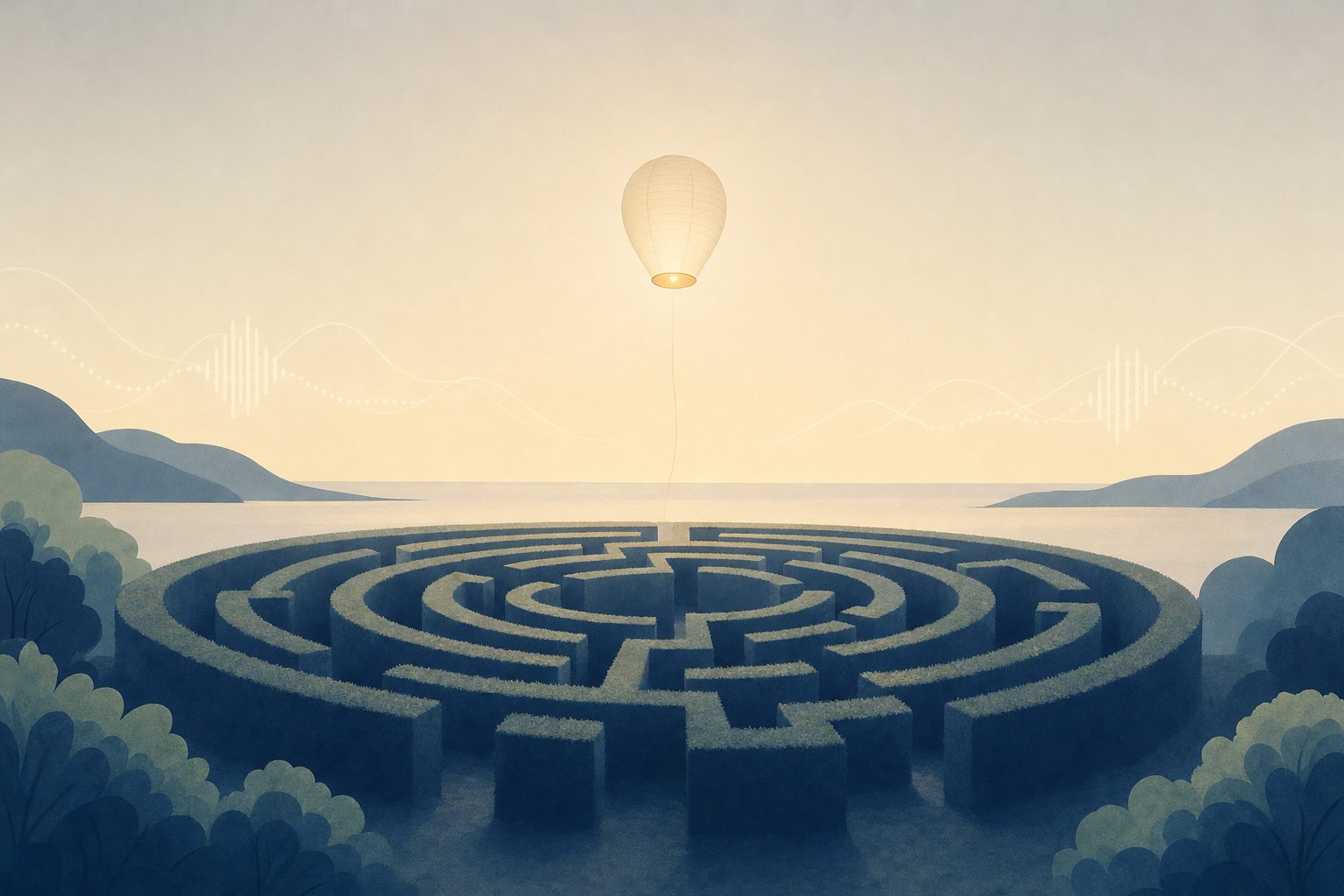
Treatment itself can become a maze, she said. At 58:19, she explained that the maze on her cover cannot be solved, and at 58:26 that the way out is upward, not sideways.
Is compulsive use at the root of most illness?
From 05:28, she made a broad claim. In her view, almost all medical and mental health illnesses have compulsive use at their root, and at 07:21 she named alcohol, sugar, drugs, and trans fats as drivers of heart, lung, and kidney disease.
At 09:10, she described refined sugar, cigarettes, and video games as products designed to hook people, so it is not the person’s fault. She teaches the difference between something that feels good in the moment and something that makes you feel good about yourself.
At 10:31, I admitted that this is not easy for me either. A good meditation can be undone by a bag of pretzels in the kitchen.
What does good therapy actually look like?
At 12:26, I asked what proper therapy is, because I have tried to find the answer. At 13:41, I compared specializing in one named method, such as dialectical behavior therapy (DBT), to learning only how to kick in kung fu.
From 13:54, she said she is not against any method that helps. Still, she believes the relationship is the most healing part of therapy, and that a person cannot simply think their way out of compulsive use. Changing thoughts treats a symptom. In her view, care also has to reach the pain that shaped the thinking.
Can trauma hide inside an ordinary childhood?
At 15:21, I described people who call their childhood uneventful until they look closer at emotional neglect. She agreed at 16:05 that the harm is often not intentional, since parents can simply be overwhelmed.
Interestingly, she noted that some people do not remember what happened to them until much later, sometimes not until they have children of their own. Her conclusion was that people have to face what happened in order to heal it. She added that she does not blame anyone.
Where do 12-step programs fit in her approach?
At 18:31, I said I had the impression her book was critical of 12-step programs. She answered at 19:32 that she critiques the most popular models but still recommends the 12-step programs and values their spiritual, not religious, side.
Still, her concern is the moral inventory. When a person who was abused as a young child is asked what their role was, she said, the question can reenact the original shame. She described her own relapse after more than two decades of sobriety, and the realization that she did not know how to love herself.
Where does medication fit?
At 28:41, I quoted Dr. Michael Miller’s point that too many doctors do the medication part of care and not the therapy part. From 28:58, she described people coming out of programs on many medications, and others she has seen struggle for months to come off antidepressants.
I disagreed with her at 30:51 about buprenorphine. A person taking it is not acting addictively, I said, although they do have physical dependence and get physically sick when they try to stop or even reduce it. We agreed at 31:21 that there should be a plan for reducing it gradually.
At 31:41, I raised benzodiazepines, which create a very strong dependence even when they are not used addictively. At 34:11, she was clear that people should always ask the doctor who prescribed a medication how to come off it, and that her role is the work underneath.
Is harm reduction giving up on people?
At 39:39, I asked whether some people can only be kept safe until they are ready. She does not give up on anybody, she said at 40:27.
At 42:01, I described a supervised consumption site whose director told me that staff build trust with people who would otherwise ask no one for help. However, that site did not hand out drugs or money. She agreed at 43:32 that the relationship matters, though she was not sure she would recommend that approach.
What can a person do in a hard moment?
At 48:02, I asked what a listener sitting in front of a pile of drugs, or a whole pizza, could do in that moment. She suggested stopping to ask whether this is why they are here.
From 50:08, she offered steps. Find a group where you feel connected, take care of the basics, practice gratitude, and turn the old fixation into a hobby. Be the love you want, she said, and you will have it.
Who is Donna Marks?
Donna Marks, EdD, works in a concierge therapy practice in the Palm Beach area and was trained in behavior therapy and cognitive therapy in her graduate program. She is the author of three books, including Exit the Maze, and at the time of our conversation was preparing The Healing Moment: Seven Paths to Turn Messes into Miracles. Her blogs and free meditations are on her website, drdonnamarks.com.
What can listeners take away from this conversation?
Her central message is that stopping a substance is only half of the work. The other half is learning to care for yourself the way a loving parent would. Yet the conversation also shows that physical dependence on a prescribed medication is a separate matter, and coming off one safely belongs in a plan made with a doctor.
How do I approach this today?
My thinking has kept developing since this conversation was recorded. Today my practice is built on one idea that runs through all of it: when the body has adapted to a substance, the safest way off is usually gradual, with the smallest steps the person’s nervous system can tolerate. Physical dependence is not addiction.
A person who took a medication exactly as prescribed and now cannot stop it safely needs a plan, not a label. Where a medication can make the process gentler, I use it. Patients direct their own care, and a good plan includes the risks, the alternatives, an exit plan from day one, and the right to change course.
For benzodiazepines and sleep medications such as zolpidem, I follow the Ashton Manual, written by Professor C. Heather Ashton, and the Maudsley Deprescribing Guidelines. That often means a crossover to diazepam, whose long action smooths out the day, and then small reductions with holds whenever symptoms flare.
When tablets can no longer be cut small enough (I never split a tablet beyond quarters), the taper moves to a liquid so the steps stay gentle. A diazepam taper can continue on the liquid down to about 0.1 mg. A taper is not treatment for addiction. It is careful medicine for a body that has adapted.
Call 911 or go to an emergency department if there is a seizure, confusion or hallucinations, or thoughts of self-harm. For thoughts of suicide or any mental health crisis, you can also call or text the 988 Suicide and Crisis Lifeline.
This page is educational. It is not medical advice, and listening to the episode or reading this page does not create a doctor-patient relationship. Decisions about starting, continuing, or tapering any medication should be made with your own physician.
Full transcript
A note from Dr. Leeds: my guests speak from their own experience and expertise, and the terminology they use is their own. Whatever the topic, this show holds to one distinction: physical dependence on a prescribed medication is not addiction. This transcript is educational content, not medical advice, and nothing here creates a doctor-patient relationship.
Read the full transcript (59 minutes)
Dr. Mark Leeds [00:00] Dr. Donna Marks, welcome to the podcast.
Donna Marks, EdD [00:03] Thank you for having me on your show.
Dr. Mark Leeds [00:05] Thank you. So, yeah, tell me about your book. It’s very interesting to me, Exit the Maze, One Addiction, One Cause, One Solution.
Donna Marks, EdD [00:16] Thank you for asking. It just came out last week in a revised edition. I originally wrote it and self-published it and it won so many awards that I was telling somebody about it and they put me in touch with a book agent and it was republished by Beyond Words Publishing they’re wonderful and it got released on Amazon it’s being distributed to bookstores by Simon & Schuster but it’s also available on Amazon Barnes and Noble and all the other sites and my webpage, drdonnamarks.com.
Dr. Mark Leeds [00:54] Oh, that’s great. Yeah, definitely. People listening, go visit the webpage, drdonnamarks.com. And that’s incredible that you started out by self-publishing because I know that’s not easy. Tons of people self-publish books on Amazon all the time that might never even be seen. So to not only have readers, but to also win awards that way and to get the attention of a big publisher. I mean, that’s really incredible. People are really tuning into your message.
Donna Marks, EdD [01:23] Thank you. I’m actually doing a Palm Beach Writer Society here in Palm Beach, and I’m actually doing a presentation from self-published to finding a publisher and the steps and missteps involved in that. So I could probably write a book about that. It’s a real learning curve.
Dr. Mark Leeds [01:41] Yeah. Yeah, in fact, maybe we can talk about that later because I’d like to one day move in that direction. I self-published a couple of books just for the fun of it, really just to get my name on Amazon in case anyone ever happens to type it in the search bar. But yeah, of course, I’m sure a lot of aspiring authors or actual authors who want to get the word out that way through a book would love to learn. I well so far they’re really just collections of blog posts I love blogging I write blog posts all the time I write blog posts for other people also you know that’s kind of my new job is I’ve become a ghost writer for some different websites and you know seo writing but every once in a while yeah every once in a while I’ll collect all the blogs on a topic and you know I put one up on opioid addiction and I took I took that one down because I felt like some of the material was dated and it was from my early blogging days. And I have one up on alcohol treatment and I want to put one together on benzodiazepine tapering. And the good thing about collecting blog posts and making each one a chapter is that the material is already written. I just have to put it together and publish it.
Donna Marks, EdD [02:53] Yes. I like blogging too. On my website, I do one every week and then people register to receive them. And it’s fun. And you can really get you can really get a lot packed into a thousand words or less so it’s a very powerful way to kind of download information and so people can you know it’s very palpable you know here’s the here’s the how you identify it here’s the steps here’s the solution and it helped I get a lot of really great feedback on blog so I’m sure you do too
Dr. Mark Leeds [03:26] Yeah yeah blogging is a great way to communicate and to you know you know get your message out definitely now about your book
Donna Marks, EdD [03:35] Dynamic book it’s hard to get people to read them you know they like the blogs because again it’s like tight and easy to you know read with coffee in the morning and stuff like that so and the young people now they’re really into you know hit me quick with it
Dr. Mark Leeds [03:52] Oh yeah yeah people yeah books can be overwhelming you know then and then people like audio books you know they like you know, especially traveling or being on the road every day, you can listen to like a little bit at a time. And before you know it, you’re through 20 hours of an audio book.
Donna Marks, EdD [04:06] Right? My books available on Amazon and audio. The only problem is each chapter has personal exercises. So because I explain things, and then I say, here’s some exercises you can do. And it’s not forced, of course, but the people are really reporting that getting great value. It’s like self-therapy, which isn’t enough, by the way, but it’s certainly a good component because the questions that are asked at the end of each chapter are personalized and are designed to promote healing for people to be able to say, yeah, this has happened and this is how I feel and here’s what I can do about it.
Dr. Mark Leeds [04:44] Yeah, that’s great. Well, an audiobook can be like a gateway to a written book, you know, because I’ve done that where I listened to an audiobook and I hear things, I’m like, I wish I could hold on to that, but there’s no way to search the audio book. So then next thing I know, I buy the Kindle book just so I can search and highlight and save things. And so, yeah, I mean, you know, someone might listen to the audio and they’re like, wow, I love these exercises. I want to get them in writing so I can try them. And then they go get the Kindle or the paperback or hardcover or paperback right now?
Donna Marks, EdD [05:12] It’s on paperback and it’s probably going to stay that way to keep it cost effective. But it’s always nice to have a hardback version of course
Dr. Mark Leeds [05:22] Oh yeah yeah but you but you don’t want your book to be just laying on a coffee table not being used you want people to read it and get something out of it
Donna Marks, EdD [05:28] Yes and you know as a doctor you understand the importance of documenting what you’re saying and in my in my book exit the maze and I’ve written three books but on all of them I document what I’m saying I have the research it’s been updated because the first book came out and then two years ago so A lot’s happened in regards to addiction, substance abuse, treatment, and all that in the past two years. As you know, with the fentanyl crisis and the opioid addiction, the deaths, the suicides, the depression, it’s all interrelated, in my opinion. Almost all medical and mental health. I didn’t say all, just almost all medical and mental health illnesses are at the root addiction.
Dr. Mark Leeds [06:15] Okay. Oh, that’s interesting. Yeah, because and there was some mention, I think, and it might have been the foreword of the book, but there was mention of the addiction epidemic. And, you know, or maybe I don’t know if it was epidemic or pandemic.
Donna Marks, EdD [06:33] I say it’s pandemic. Yes, it’s worldwide.
Dr. Mark Leeds [06:36] Yeah. So, I mean, it clearly is. And, you know, and there’s tools that are proven to help with certain addictions. You know, there’s medication assisted treatment, definitely for opioids that can be life saving, especially with fentanyl out there. And we saw how fast they jumped to make vaccines, you know, for COVID. You know, and that’s the big question. Why is nobody jumping in that same way for addiction when addiction is so widespread?
Donna Marks, EdD [07:05] Right. If people weren’t addicted anymore, the medical industry and the pharmaceutical industry would collapse.
Dr. Mark Leeds [07:12] Yeah yeah so
Donna Marks, EdD [07:14] Unless they converted to prevention instead of treatment
Dr. Mark Leeds [07:18] Yeah yeah and there’s tobacco alcohol gaming
Donna Marks, EdD [07:21] So it’s alcohol sugar drugs and trans fats that cause almost all medical major medical illnesses and death heart attack heart attack stroke lung disease kidney disease I mean, I see it constantly. People come in here, you know, they have a kidney disease or they have a lung disease, but it’s really they have an addiction. Yeah. They have an addiction. Diabetes, too. Stroke. All related to people consuming toxicity to the level that it causes permanent organ damage or brain damage. Then they have a brain disorder. Yeah. And then we got to treat that with pharmaceutical, you know, psychological medications. And so, you know, if people, if the addiction is caught in time, like any illness, you know, if you catch it at stage two cancer instead of stage four, your recovery rate is much better. The hard thing with addiction is helping people to understand that they have those early signs and symptoms and they don’t need to go to stage four where their brain is damaged or their heart or their lungs or their kidneys their you know adrenal glands or whatever you know they’ve caught it in time and they can live a perfectly happy normal life without the addiction yeah yeah but that connection isn’t being made and that’s very disturbing that connection you know it’s kind of Oh, yeah, whatever. It’s profound.
Dr. Mark Leeds [08:47] Oh, yeah. Yeah. Well, that’s, you know, the food industry is powerful. The sugar industry, you know, here in Florida, you know, apparently the, you know, the Everglades are being destroyed by the sugar company. And, you know, of course, they win in the end because that’s where the money is. So, you know, that same sugar is everywhere, you know, that being baked into all kinds of things.
Donna Marks, EdD [09:10] Sugar is a really powerful addiction. And as I say in my book, there’s one scientist that says it hits that frontal lobe like crack cocaine. And, you know, it’s refined, which, you know, things are made to get you addicted. That’s what I’m trying to help people to see. Like, it’s not your fault. You know, a cigarette, you know, they were adding additives to make it more addictive. Refined sugar is more addictive than sugar raw because it’s so refined. You’re getting such a stronger hit in your brain when you when you eat it. You know, pornography is designed to get you addicted. I mean, this is like not an accident. You know, even video games, all of it gets you charged. It gets that it gets that adrenaline flowing. It gets your endorphins surging and dopamine and all that. And that’s what people are addicted to the feeling. And so once they you know what I teach people is there’s a difference between doing something that makes you feel good in the moment versus something that makes you feel good about yourself and once they learn that they walk away from it like any other bad relationship like what am I doing here it just isn’t serving me I don’t it’s not worth it that few moments it’s just not worth it but again you got to catch it early enough to where there’s big benefit to stopping yeah the longer it goes the harder of course it is because your brain does become disordered damaged
Dr. Mark Leeds [10:31] Yeah and it’s I mean just from personal experience I can say it’s not easy that you know I can I can go out in the backyard and sit in a chair and meditate and you know there’s birds and squirrels and wind in the trees and it’s beautiful and relax and think like wow I’m doing really great you know then I can sit at the computer and write a blog post and you know build something and put something together and like, wow, I made something and it wasn’t easy and I did a great job and I feel great about myself. But then the problem is I walk through the kitchen, I’m like, oh, look, a bag of pretzels. That would taste really good. I can just put some in a cup and I know I’m not supposed to have them, so let me go hide them somewhere. And next thing you know, I’m like back to square one again with that.
Donna Marks, EdD [11:12] Yeah. So yeah, because once you activate those centers in the brain, there’s more and more and more. So the key there is not getting it to begin with and getting things that do taste good to snack on that are nutritious.
Dr. Mark Leeds [11:26] Yeah. So fill the kitchen with, yeah, which is, you know, of course, someone who’s trying to get over a cocaine addiction is not going to, you know, first thing, get the drug out of the house or opioids, you know, get the pills out of the house. Absolutely. Absolutely. It’s not so easy, you know, you know, getting all the alcohol out of the house, you know, because some people can control their drinking, although no alcohol is really good for anyone. It’s hard to convince people, let’s get all the bad stuff out of the house.
Donna Marks, EdD [11:55] Right. I think when you’re first detoxing to reduce the stimuli that would trigger someone to think about it when they may not be thinking about it is a good idea. But after a month or so, with proper treatment, I don’t believe that most facilities are properly treating people with proper treatment, that person is feeling so good and has replaced the alcohol with things that they enjoy doing so much, it never bothered me to be around anything that I was addicted to.
Dr. Mark Leeds [12:26] Yeah. So what is proper therapy? Because I’ve tried to find the answer to that. Psychiatrists are not doing therapy for the most part. They write prescriptions. Right.
Donna Marks, EdD [12:39] They treat addiction with addiction.
Dr. Mark Leeds [12:41] Yeah. And damage drugs that also damage the brain, you know, psych drugs. And, you know, if you go to rehab, most rehabs don’t have a psychologist or a counselor or therapist. I mean, they might have counselors with minimal training. And, you know, there’s pretty much no real therapy other than, you know, people sitting around in a group who have the same problem talking. You know and so you know and then there’s there’s all kinds of therapy there’s you know the cognitive behavioral therapy the what’s the other one the dialectical so dbt whatever that is
Donna Marks, EdD [13:12] Yeah dialectal behavior therapy which is also cognitive and
Dr. Mark Leeds [13:16] Yeah and then there’s a I think similar to dbt there’s the acceptance and commitment therapy which yes to me you know it sounds intriguing because you know you’re accepting things the way they are and committing to do something positive.
Donna Marks, EdD [13:32] Right. But those should be like included in any therapy as segments, not as the whole. Yeah. Yeah.
Dr. Mark Leeds [13:41] There’s people that supposedly go and train and specialize in each of those kinds of things. So yeah, it’d be like, like learning Kung Fu and like, I’m just going to learn how to kick, you know, I’m going to be a kick expert.
Donna Marks, EdD [13:54] Right. Right. But that’s a good analogy. And, you know, I’m not anti any, you know, whatever helps. But I think that what’s really helping people when they go to therapists is that they feel supported and cared about. And it’s the relationship that is the most healing thing. And yes, if you acquire some tool that helps your thinking, that’s a good thing for sure. But just thinking your way out of addiction is not going to do it, even no matter how rational, logical or how you shift your mindset. Or, you know, whatever techniques you’re using. And honestly, I can’t keep up with them. It’s just overwhelming. And that can, you know, like that can really foster a sense of inadequacy in treatment too, that, oh, I don’t know this. I don’t know that. I better go get this. I better go learn that. And to me, that can really be very dysfunctional. But, you know, treating symptoms again, if your thinking’s wrong, you’re treating the symptom rather than the problem, which is what happened to cause that kind of thinking? What’s the trauma underneath that? What’s the disorder underneath that? What’s the dysfunction that began? Where’s the pain associated? What had happened in the past that’s created a particular mindset in the here and now? So I was actually trained in behavior therapy and cognitive therapy in my graduate program, and I like it. It has its place. But again, it’s a symptom treatment and not an underlying cause treatment. And I do believe we have to do both.
Dr. Mark Leeds [15:21] Yeah. And when you talk about trauma, I mean, there’s definitely people that have been through some horrific things growing up, you know, things that no child should have to go through. But then you also have a lot of people with addictions that, you know, when you ask them about their life growing up, it’s like, well, it was uneventful. You know, I had two parents that worked and, you know, they gave me stuff that I needed and, you know, and there was money and food and nothing was especially bad. And then when you dig deeper, it’s like, well, my siblings tortured me. And, you know, my parent, my father was never home because he’s working so hard to make the money. And my mother is kind of self obsessed and preferred my other siblings. And so there’s all kinds like other kinds of abuse, I guess, like emotional abuse or how would you describe that?
Donna Marks, EdD [16:05] Yeah, it doesn’t, it’s not necessarily intentional abuse. It could just be that parents were overwhelmed. They had four kids and you know both were working and you know they didn’t intend to abuse I don’t think anybody really I mean there are sadistic people who are sadistic with their children but that’s really rare and that’s at the extreme spectrum but you know things like emotional abuse neglect sexual abuse sexual abuse is rampant and it’s even getting worse because there’s this whole movement to neutralize that it’s like a preference and a and a choice you know kids are not equipped to be emotionally detached or be abused and, you know, physically, sexually, emotionally, to be used as surrogates for their parents in terms of, you know, the support system. They’re supposed to be children. They’re supposed to just have their needs met. It’s not up to them to take care of the family. The parents are supposed to take care of their kids. And of course, as they get a little bit older, you know, past age two, three, four, they assume little responsibilities and they are part of a team. And that’s very important in terms of social skills and all. But kids who sometimes they don’t remember the abuse. I was working with someone recently who had been raped repeatedly by a cousin and who was much older and didn’t remember it. I was working with somebody else about six months ago who didn’t realize how abused he had been by a parent. Until the person had his own children. And then it was like, holy, what’s going on with me? So these things can’t just be cognitively addressed. They must be, I mean, you can’t just say it’s unfortunate or I’m gonna hang in here no matter what. I mean, those are all good things, but you’ve got to be able to process the pain and the trauma that were affiliated around those specific events. And again I don’t blame I don’t blame anybody I don’t blame psychiatrists for writing prescriptions they have their place it sometimes saves lives as you said I don’t blame pharmaceuticals I don’t blame the government I don’t blame parents but we must face what has happened so because if you can’t face it you can’t change it you can’t heal it you can’t correct it
Dr. Mark Leeds [18:31] Yeah yeah and now in your book, I don’t think that you especially like or recommend like these 12-step programs like Alcoholics Anonymous and Narcotics Anonymous. Although to be fair to them, I don’t think most people do the full program. You know, they have the 12 steps that people, you know, someone is supposed to go find a sponsor and do a lot of writing and talking and introspection and, you know, looking at themselves and, you know, monitoring their behavior and their whatever, the meditation, prayer, all that stuff. So, you know, I kind of think of it as like, imagine if people came to your office for therapy and a bunch of them sat in the waiting room waiting for their appointment. And then 90% of them decided never to come in for the therapy. They said, well, I kind of like the waiting room experience. And, you know, so you kind of, but then again, I mean, it’s not really therapy. It’s not guided by a professional. It’s just people all in the same situation trying to help each other out and maybe someone a little further along.
Donna Marks, EdD [19:32] Well, I can see why you would think that I don’t recommend it, but I do highly recommend. In fact, I recommend the 12-step programs over any form of treatment. It is as successful as any other outrageously expensive treatment, and I think it’s very important. I think the reason you said that is because I do critique it. I critique all the different models that are, you know, not all of them, but most of the most popular models that are currently available. And the 12-step programs are a wonderful way to quit drinking it is a behavioral program you stop doing the behavior and here and here’s the steps of how you stay stopped and it is the spiritual based program which I think is very important and what I like about it is that it’s not a religious program it’s like figure out who god is to you and use that and that works really well when people understand it you know for some people it’s music you know they listen to music and they get that uplifting all is well feeling for some people sitting in their backyard, listening to the birds, taking in the fresh air, listening, watching the squirrels, you know, that puts them on the zone, whatever it is, it doesn’t matter. It doesn’t have to be some deity. In fact, my next book is about that kind of thing of finding what works for you and having those magical moments because of it. But the one thing I would say about the 12-step programs is that they very importantly have you do a moral inventory of yourself, you know, who you’re mad at, why you’re mad at them, and then they ask you to look at what was your role in that. And so when those of us who have suffered severe abuse in childhood get to that point and we say what was my role in that just reenacts that whole sense of shame because I already felt like I caused it even though a four or five year old cannot possibly cause sexual verbal physical abuse and neglect. It’s impossible. A three or four year old to have caused you relive that shame and you get stuck there. You get stuck there. Like it’s not okay to feel this way or to look at this. I just have to move on and stay sober. And often what happens is people will, like I did, they will continue to reenact those types of dysfunctional relationships. And they like myself after many years or very few days, they’re not able to stay sober. Yeah. But that’s the third part of when I treat people and what I recommend in the book. You have to stop. You have to deal with the underlying trauma. And a lot of treatment centers do that. But you then have to learn how to love yourself. People who have suffered childhood abuse do not know what that means because their template, I talk about templates and imprints in the book, their template is that their parents told them they love them, but their behavior was not loving. So they’re confused. I was very confused. I had no idea. I was sober for 23 years and relapsed because I did not know how to love myself. I kept reenacting those primary relationships and finally just said, Screw this program. Screw this whole situation. This isn’t working for me. There was a lot of other things going on too, like cancer and death of a former spouse and fires and hurricanes that were downloading me with constant unmanageable stress. But the bottom line was, you know, when I had that second bottom, it was like, it was revealed to me very clearly from my higher power. You know, I’m like, why don’t you love me, God? I’ve tried so hard to do all these right things. You don’t love yourself. And that was my, that was my moment, my awakening, like, whoa, what does that even mean? You know, it’s true, but what does it mean? And people that come in here to the office, when I ask them, you know, do you love yourself? Some of them will say yes, some of them say no. What does that mean? Let’s look at your behavior from the time you wake up in the morning to the time you go to sleep at night. Let’s just kind of review your day. And I say, think of it like you’re the parent now and you have this beautiful, wonderful little child. Are you giving them breakfast? Are you feeding them a bowl of sugar? Are you feeding them nutritious food? Are you educating them about how important and sacred their bodies and their brains and their heart and their lungs are? Are you smoking cigarettes? Are you giving them cigarettes? Are you having a martini at lunchtime? I mean, are you taking, I tell them, don’t go out and play, don’t exercise, you know, stay inside on your video games. I mean, of course, those things are happening all the time, but that’s because we’re confused. We don’t understand. So I teach people how to love themselves, how to identify their emotions, how to discuss them from a place of love, not attack and not blame, but from a place of love. This is how I feel. Or I’m being triggered in this relationship because when you do X, Y, or Z, it reminds me of when I was ignored. It reminds me of when someone was unfaithful to me. It reminds me of how my parents were, not to blame you, but to share with you why I’m having this reaction right now. And I would really hoped that we could talk about things before we act out for pain and those kinds of conversations. I mean, it’s not easy. That’s why I have a concierge practice because it’s a full immersion and people actually learn how to totally relate differently to themselves and their loved ones.
Dr. Mark Leeds [25:20] Yeah. And that’s the thing. You can only, to put that much effort into helping people, you can only help so many people. But then you have a book, you know, for the people that are not able to get an appointment with you they can you know easily get access to you know your kindle book is very affordable it’s very accessible it just takes a second to go download it and then you know and if someone doesn’t have time to sit down and read they can get the audio version and put it on in the car and exactly get into that so exactly
Donna Marks, EdD [25:50] And you know again people have to be willing like you said like a lot of people no matter where they go for help when you say, okay, now here’s do this, do this, do this, wave your magic wand, you know, no, love means putting forth the effort into yourself. Love means taking your life seriously. Love is an action word. It’s not just a feeling. Again, you have to decide to do the things that I’m recommending to you so that you feel good about yourself rather than continuing to go for that instant gratification of feeling good in the moment, which always has a terrible price to pay to your emotional well-being, to your self-esteem and to your physical health, to your relationships. All of those things cause great harm, mainly to yourself.
Dr. Mark Leeds [26:44] Yeah. And, you know, when we talk about trauma growing up and, you know, I was like, while you were talking about that, I was imagining, you know, people in a war zone with, you know, bombs going off and friends being killed next to them. And, you know, they come back with trauma, they come back with PTSD and, you know, and maybe that’s a major thing of, you know, a soldier comes back from war and they think, you know, look, I’ve killed people, I’ve done horrible things, but they were put into a situation where they, maybe they had no choice, you know, you either do your job or you’re in big trouble and you get caught up in, you know, the psychology of war, however that works. And I was talking to someone in another podcast episode about how they’re using that MDMA drug, which again, you know, quick fix, you know, give someone a drug, but you know, the drug that gives a person a sense of feeling love and connection. And it never occurred to me, this guy said, well, maybe the usefulness of it is that it helps a person to kind of jumpstarts their self-love. You know, maybe they can look at themselves and say, maybe I’m not so bad, although clearly that’s possible without giving someone a drug to make them feel that way.
Donna Marks, EdD [27:54] Some people have done the gamut of therapy. I think that I’m not opposed to MDMA, especially with war vet PTSD, because the evidence is coming in. I’ve talked to some people who administer it and who have undergone the treatment, and I do believe they have benefited from it but I don’t think it should be the first resort and the problem with it is that they might heal that specific trauma but if they don’t learn how to same as any other thing if they don’t learn how to love themselves which means engaging in behaviors that keep you physically and emotionally healthy and feeling good about yourself then it’s only half like any other form of treatment is only half of it.
Dr. Mark Leeds [28:41] Yeah. Yeah. It’s like there’s a doctor, actually, Dr. Michael Miller, I love reading his posts on LinkedIn. And he always says, you know, in medication assisted treatment, too many doctors are doing the M part and not the A part, which he means by, you know, we’re not doing the therapy and the work, you know, just giving people a prescription.
Donna Marks, EdD [28:58] So many people I’m seeing coming out of treatment on different kinds of, I mean, there’s just a gamut of medications. When I went to treatment in 1986, they didn’t give anybody medication for a year, unless they were severely psychotic, you know, or suicidal. And they said, let’s give your brain a year to re-regulate. And yeah, I personally don’t believe that addiction is a brain disorder. I think your brain becomes disordered from addiction, but it can heal if with the proper nutrition and therapy and lifestyle. But now it’s like standard procedure, whether, you know, it’s almost all medically assisted treatment, the insurance companies pay for it. Yeah the relapse rate might be less but you’re still addicted you’re going on suboxone and all these different drugs and you’re hot they are try getting off of them after you’ve been on them a while a lot of the antidepressants even though they’re not mood altering I have seen people in my office months and months and months going through pure hell trying to get off these some of these antidepressants and then giving them to children when they’re young is really you know, while their brain is developing, that brain is never going to be normal. It is conditioned to the drugs that it was on. And we know that children, even though there’s so much research to the contrary that, you know, ADH drugs, Ritalin and Adderall, you know, don’t lead to addiction later on. Well, those studies are mostly done by pharmaceutical companies and people who want to sell the drugs. So you have to dig deep, but there is research. I mean, it only common sense, you know, and I have a lot of young men that I’ve worked with in their 30s and all. They’re like, I was definitely amped up on it. And I took extra to get that good glowy feeling and, you know, really charged up and trying to get off of it is a nightmare.
Dr. Mark Leeds [30:51] Yeah. Yeah, that’s true. I mean, I would disagree on the thing of suboxone, buprenorphine, that when a person is taking it, they’re not acting addictively. So it’s definitely a major issue of dependence. You have physical dependence. They get physically sick when they try to stop taking it or even to reduce it.
Donna Marks, EdD [31:10] Right. But you have to be weaned off of it while you’re in therapy. And like you said, they get the scripts and they keep getting the scripts.
Dr. Mark Leeds [31:17] Oh, yeah. There should be a tapering process.
Donna Marks, EdD [31:19] The treatment part is missing.
Dr. Mark Leeds [31:21] Right. Yeah, there should be a plan. You know, you’ll reduce it gradually over a period of time and eventually you’ll be done with it. You know, there should be an end plan.
Donna Marks, EdD [31:32] That’s the way it’s designed, but that’s not what I’ve observed in the people. And that’s certainly not the entire world population, but the few people that I’ve worked with who are on it can’t get off.
Dr. Mark Leeds [31:41] Yeah. Yeah. And that’s also another category. There’s people who are dependent on benzodiazepines, you know, and not really addicting drugs, but I create a very strong dependence I mean it probably worse than opioids
Donna Marks, EdD [31:56] They’re psychologically addictive
Dr. Mark Leeds [31:57] Yeah
Donna Marks, EdD [31:58] And they’re debilitating because you go to the doctor you’re you’re feeling anxiety I don’t even believe in the anxiety I call it fear let’s talk about your fear and how we can help you to overcome it but anyhow that’s you know that’s what I do but they go to the doctor that I’m feeling so anxious I can’t sleep I’m shaking and no, no, no, no, no. My mind is racing. Oh, you’re suffering from a chemical imbalance. You can’t help it. It will never get better. Here’s your benzodiazepines. And, you know, they do get high and sometimes people are inclined to use them. There is an extremely high overdose rate because people drink and take benzos and their brain, like the opiate crisis and the fentanyl crisis shuts down and they die in their sleep they are they overdose and it’s all over there’s not enough warning about this try getting someone off of it I mean I’ve worked with people who’ve gotten off of everything but there have been so’s and I can’t I can’t do that I mean I just can’t function you don’t know how bad my panic attacks are you just don’t understand I’m like well until you get to understanding the root of your fear like and sometimes these people it’s bizarre sometimes these people do like extreme sports I mean you can overcome your fears of that sometimes people are surfboarders out there with great whites you know but yet they have panic attacks on randomly I mean come on however you learned how to drive a car or get on a surfboard when you knew you were sharks you can get over anything and it’s just a matter of being willing. But that psychological dependence, you know, I don’t want to let go of my blankie. You know, what will happen? What will happen the first time my heart starts racing and I can’t breathe? What if I, you know, well, nothing’s going to happen. You might get a little dizzy, but nothing’s going to happen. You didn’t die before you went on the benzos and you’re not going to die if you get off of them, especially learn how to love yourself.
Dr. Mark Leeds [34:04] Yeah. Well, of course, you know, the getting off is not an easy thing. That’s like a also a tapering process and something. Any kind of medication.
Donna Marks, EdD [34:11] I don’t. People ask me, I said, you have to ask your doctor who prescribed it. I don’t care what it is. You know, even pot, you know, get find get a medical person to tell you how to get off those drugs. That is not my job. My job is to teach you how to stay off of them by dealing with the pain underneath it, the fear underneath it. And to be able to learn how to love yourself instead of taking pills but definitely always talk to doctors before you go off of any medication
Dr. Mark Leeds [34:44] Yeah there wasn’t there used to be a there was a doctor that used to tell me about some kind of a this guy that he was known as like the love doctor like he would lecture everybody on love and he would hug people at his conferences and stuff and a Bernie Siegel oh okay
Donna Marks, EdD [35:00] Yeah he treated he said that he’s kind of treated cancer with the same type of approach similar to me but it was specific to cancer oh
Dr. Mark Leeds [35:12] Okay okay
Donna Marks, EdD [35:13] He wasn’t addressing he didn’t he wasn’t claiming like I am that almost all cancer is related to some form of addiction yeah that people have smoked or eaten things and that have cause them to be, you know, not just what you’re ingesting, but also you sit around, you don’t exercise, you’re not engaged, you get depressed. You know, it all ties in together.
Dr. Mark Leeds [35:37] Yeah. Yeah. I mean, like they refer to, you know, watching television now as binging, and now that’s become an acceptable thing. Like I’m binging a show and I sit on the couch all day and watch every episode until I’m done and then find a new one to get into.
Donna Marks, EdD [35:53] It’s another escape. Yeah entertainment reasonable entertainment yeah
Dr. Mark Leeds [36:00] Speaking of shows did you ever did you see the hbo kind of newer version of westworld
Donna Marks, EdD [36:08] No I saw the previews on it I actually saw the original version years and years ago
Dr. Mark Leeds [36:14] Yeah which the original is great I re-watched that recently But you might like at least the first season of the new version because there’s a thing about a maze. And the maze in the show actually looks a little bit similar to the maze in your book. And that kind of made me think about that. And the interesting thing was that the maze image was everywhere. And one of the characters thinks that there’s like a hidden game and he’s trying to solve the maze and get to the end of the maze and figure it out. And it turned out that the maze image was from one of the early researchers children’s games like his childhood was dying of cancer and he had a little maze he liked to play with and so he that maze got put into the thing and turned out there what I don’t think there really was a maze to be solved but yeah but that whole maze thing keeps coming up over and over again and I’m sorry I just gave I probably spoiled the show I mean that’s just a little part of it there’s a lot
Donna Marks, EdD [37:09] Not at all, but it’s interesting. Yeah. And the addiction maze, you know, treatment can even be a maze. You know, people go to treatment over and over and over again and different treatment centers and try different things. And part of that is a failed treatment system. But sometimes it’s the failure of the person to do what the treatment is telling them to do. So, you know, I don’t really think people, you know, people definitely need to be detoxed if they’re substance abusers. But not all substance abusers need to be detoxed, but they should be evaluated for whether or not they need to be detoxed. But it’s not necessary to go to treatment. It is necessary to get good treatment and to do what is recommended in treatment. But like I said earlier, I mean, getting put on a whole bunch of medication is to me contraindicated most of the time. And in terms of long-term, I mean, I want who I am. I want that. I don’t want some altered version of me. I’m fine the way I am. Yeah, I have my things. No, I’m not perfect. Yeah, I go off every once in a while, but the program teaches you can clean it up. You can say you’re sorry. You can own it. You can work on changing yourself. It’s not that hard. And I don’t believe that when we do these things to correct our addiction, it’s not hard to stop either what’s hard is when we keep fighting it and we resist doing the things that would make it easy to stop so you know the maze is one one of the big reasons that treatment doesn’t work is because the addiction which I call the invisible hole you know something’s missing you know there’s this big void inside of me and something’s missing okay so I have an alcohol problem I go to treatment I stop drinking and then I start using the drugs they gave me in treatment or I stop cocaine and then I start gambling or I stop gambling and then I’m into porn or I quit smoking and then I’m eating you know it’s just it’s never ending so that’s why I say there’s just one addiction only one it’s that hole that we’re trying to fill and once we learn how to heal what caused that feeling of inadequacy and then replace it with behaviors that are loving ourselves then we don’t we’re out of the maze and we didn’t try to get out of it we just elevate out of it we’re not going up and down the corridors anymore looking for the fix
Dr. Mark Leeds [39:39] Yeah so what do you what do you think about like with the you know, they have the stages of addiction. People talk about the six stages of addiction. And the first stage that pre-contemplation where a person is supposedly unreachable and not that they’re completely unreachable, you know, you can maybe plant the seed of like, you know, there’s stuff, you know, there’s tools waiting for you. There’s people waiting to help you when you’re ready for help. But then that goes into harm reduction and, you know, supervised consumption sites, you know, giving people clean needles and stuff and maybe making safer drugs available to them. How do you feel about that? Do you feel that there’s people that are actually in a place where there’s no way to get them out of their addiction other than just to maybe keep them safe until they’re ready?
Donna Marks, EdD [40:27] I don’t believe that anybody is impossible. I really don’t. I don’t give up on anybody. And I’ve had some people in here who were way, you know, it might take a really long time before they are willing yeah but it’s I don’t give up on anybody and so when we start passing out needles and free drugs we’ve given up on them and why would we do that what’s the point of that I don’t understand that so that so what so yeah they’re dying anyhow they’re killing themselves now we’re helping them to do it
Dr. Mark Leeds [41:01] Yeah well I mean oh yeah no that’s yeah I’m not really completely sure how I feel about it either. But I mean, it’s, you know, like you said, there may be someone that’s not not that they’re hopeless, but they’re not reachable right now. And you know that they’re going to walk out, you know, maybe the parent drags them into your office, you know, like, help him, you know, he needs help. And the kid’s like smiling, like, okay, whatever you want me to tell you, I’ll say anything to get out of this room. So I can go out and get my needle and heroin, which is really fentanyl. And you know so you know that you’re not going to reach them today although you could possibly plant the seed of that we can help you know maybe next week the week after when you’re ready but yeah I mean the harm reduction will be like well let’s keep him alive tonight and out of harm’s way but yeah I can see what you’re saying if you if you make it the drugs and the needles all freely available maybe he’ll stay out longer
Donna Marks, EdD [41:56] He’s not coming back
Dr. Mark Leeds [42:01] Yeah well I mean that hope I mean the hope would be you know that the that these you know like I did an interview with someone who runs a supervised consumption center and his his and they’re and they’re not giving them the drugs where they are they’re you know the people bring the drugs in and they give them a safe place to use them and his perspective was that we’re forming relationships with people that would otherwise know not go ask for help from anyone And over time, as they get to know us and develop trust, we can hopefully lead them in the right direction to finally getting help. I mean, these are mostly probably homeless people.
Donna Marks, EdD [42:35] Does he have anybody that’s done that?
Dr. Mark Leeds [42:37] Oh, yeah. One of his best trusted workers had overdosed and had his overdose reversed like 30 plus times with Narcan or Naloxone. And he finally came around and decided to get help and recover. And he’s now, you know, one of his most important workers and he’s helping other people.
Donna Marks, EdD [43:00] OK, but you said he overdosed. So he wasn’t getting treatment from that facility that was giving free drugs.
Dr. Mark Leeds [43:07] Yeah, I would assume that, you know, because also they told me that no one has ever. I don’t know. What do they say about that? Not that people had an overdose. They had almost never had to give Narcan because they were able to educate the people on not using the drugs too much. And, you know, they could give him oxygen. And, you know, so I guess, but yeah, and this guy’s, so yeah, I don’t know the full story. You know, there’s clearly more to it. Maybe all that happens.
Donna Marks, EdD [43:32] Well, I think the relationship piece is very important. And so if they form relationships with people who are addicted, love is what is going to heal somebody. But most people who are on drugs or who have addictions, the consequences have to be more painful than the benefit of getting high. So when we’re talking about people who have lost everything because of their addiction we’re kind of buffering them by giving them drugs rather than allowing them to feel the pain a lot of people and you know people that go into the 12-step program some of them are coming in from living under bridges living in the woods and they have that when they work the program and they heal they have amazing lives they find their purpose they become financially secure they have relationships they get married they have children they have friends and so they live normal lives and if we if they’ve continued to be administered free drugs that the likelihood of that happening is slim because your brain is hijacked you don’t own you anymore that pill or that liquid in that in that tube with the needle on the end of it owns you yeah so your brain is high you’re hijacked and you don’t want out you don’t want out that’s the problem yeah so I’m sure that you know if you’re hanging around other addicts and people are trying to do some therapy with you while you’re getting your free drugs and they’re caring about you and they’re encouraging you, that can’t hurt. But I don’t know that I would recommend that form of treatment.
Dr. Mark Leeds [45:16] Yeah. Well, in that particular safe consumption site, they were not giving people money or drugs. So yeah, somebody walked in the door and said, you know, I’m here. I see you’ve got all the clean needles and syringes, but I don’t have money or drugs. They would probably tell them, we can’t help you, but we’re here for you. And so yeah, I mean, Yeah, so those people are still suffering consequences or just at a lower risk for endocarditis, hepatitis C, and things like that, HIV. So, but yeah, I mean. That’s important. Yeah, but there’s, I mean, there’s good and bad arguments on all sides. But I would agree, definitely, someone going to a psychiatrist thinking that they’re going to lay on the couch and get an hour of psychoanalysis, and then they get a handful of prescriptions for a benzo antipsychotic and an antidepressant, that’s not the right way to go for a lot of people. For most. Yeah.
Donna Marks, EdD [46:09] For most, because it invalidates who you are as a human being. And I don’t believe that people are born with brain disorders or any other kind of defects. Now, of course, there are people born with defects, of course, but even people you can you can Google motivational speakers with birth defects and you’ll find at least two or three who are highly successful, very happy, productive individuals. So even with handicaps and limitations, we don’t have to be drug addicts or have addictions when we know who we really are and who we really are amazing creations. And all of us are here for a reason and a purpose and drugs and alcohol and food and all these other gambling and porn and shopping and all of that is a substitute and a defense against embracing who you really are and why you’re really here. Which is to share your gifts, share your talents, love and be loved and have a glorious life. I mean, this is a this is a playground and we’ve turned it into a nightmare. And it’s up to each of us individually to recapture that essence. I believe that babies are born perfect. Things go wrong. Again, not to blame anybody, but to understand that the children, in order to grow up without that invisible hole certain things must happen they must have secure attachments they must feel safe they must feel loved and when that happens they just automatically go about their business in life doing the same things forming secure attachments taking care of their needs and feeling loved and giving love
Dr. Mark Leeds [47:53] Yeah
Donna Marks, EdD [47:54] It’s just you know the kids that go to parties who have that are like, why are these people acting like idiots? I don’t want to do that.
Dr. Mark Leeds [48:02] Yeah. Yeah. That’s, that’s a good point. Yeah, definitely. And for people that didn’t grow up that way, the other people that had a crazy upbringing, you know, there’s still hope. I mean, you can still choose to be happy and choose to love yourself and choose to love other people. So what would you say, like for someone listening right now that’s miserable, that has like a, you know, maybe a pile of drugs in front of them or a whole pizza or whatever. And, you know, what would be the next step like right now?
Donna Marks, EdD [48:33] Well, maybe they can just stop and say, is this why I’m here? Is this why I’m on this planet to sit here and look at this pile of drugs and keep taking them and be completely hijacked? You know, I don’t have my mind anymore. I don’t have my freedom. I’m a slave and I’ve got chains around me. Or, you know, it’s so easy. It’s so easy to just pick them up, throw them down the dumpster, get to some meetings, get to the right kind of help. Try something else. I mean, I can’t hurt. It can’t hurt to have you back and to face whatever in you is so uncomfortable that it’s unbearable. Because if you face that, then you can heal it. And then you can learn how to replace all those drugs with moment to moment activities that make you feel good about yourself and make you feel loved and secure and happy.
Dr. Mark Leeds [49:28] Yeah, and what like, just give us like a few examples, like some activities that, you know, like say that we finished the podcast right now and I’m, you know, I have a food full of kitchen. I mean, of course I know I shouldn’t be eating all that. You know, I can, I’ve got a ton of work. I could do like fun work, you know, blogging and putting things together. You know, I love playing with, you know, music and things like that. […] But, you know, for your average person, you know, like which, you know, me included, like what are some positive things like, you know, probably not a Disney World trip or, you know, you know, that’s just more money and more fake entertainment, although it could be positive in some ways. But like, what’s something that someone could do right now that’s positive?
Donna Marks, EdD [50:08] Well I actually in my next book we talk about this 77 ways to self-love but I also believe I have one on my website 101 plus ways to self-love but first of all why am I doing this why am I allowing something to control me and rob me of who I am and then you know everyone that’s substituting addiction for love is really trying to connect. So I can’t tell people how to connect. I can ask them, what makes you feel connected? And it’s really important when people are trying to come off of addiction. That’s why this is one of the main reasons that 12-step programs are so powerful. When someone has gone from isolation back into the herd, even though you know often people go to those meetings and I can’t relate because their their disease is evaluating the situation I remember the first time that I went to a recovery meeting and I thought oh wow this is a church I’ve always been looking for but not everybody has that reaction so find something that you can feel love in and us for some people it’s church for some people It’s a hobby. It’s a music group. It’s a band. It’s a poetry group. It’s a nature. It’s a bird watching. It’s a jogging group. I don’t care what it is. Find something that you feel connected because you need to be around people. And you also need to get information on not just stopping, but how to stay sober because there are techniques that work and there are techniques that don’t work. But that social element is very very important then to kind of break it down to what I was saying earlier as if you were a small child you know wake up in the morning and feel some gratitude you know I used to wake up at my grandmother’s house and I could hear the birds outside and that gave me a happy feeling you know the sun was shining and the birds were there and it gave me a sense of a spiritual connection I like to pray when I get out of bed in the morning I like to pray before I go to sleep at night, but some people just aren’t into that and that’s okay. But make your bed because when you walk back in later, you’re going to feel good that you did that. That’s an example of doing something that makes you feel good about yourself. Eat healthy, get rid of the junk, eat healthy things. And I, one of the things I teach people is whatever your addiction is, you can actually turn that into a hobby or a career. So, I was recently talking to a man who had food issues and he started making recipes of some of his favorite healthy dishes and even improvising and creating his own healthy dishes. There’s some people who had sugar addictions who’ve written and published sugar-free recipes that are delicious. I’ve tried some of them myself. They’re wonderful. I’ve sometimes made sugar-free, gluten-free chocolate chip cookies. People didn’t even know they weren’t the real thing. So whatever your addiction is, you can turn that into a hobby or even a career. A lot of people who have had substance abuse issues become addictions counselors or coaches. You know, whatever your hobbies or interests are, it doesn’t have to be related to addiction. Expand on those. Get back in school. Take classes. Help other people learn those tools. There’s just so many ways to love yourself, to exercise every day. Be grateful. When your mind goes negative, this is a cognitive part of it. When your mind goes negative, counter that with something that you’re happy about. And there’s always something to be happy about. If you’re so in so much darkness that you can’t find anything, find something. Because it might even be the fact that you have a pencil on your counter. And that pencil is of value. Without pencils and pens, where would we be? And we take so much for granted. We just look at everything and oh, so what? Big deal. No. But when we’re grateful for everything around us, even, even if you’re homeless, you can be grateful for the sun and the trees and the birds. When you maintain that sense of appreciation, you start looking and noticing things and be the love that you want. You know when we’re addictive we’re trying to get get get one of the things I talk about in my books is to have love be the love that you want and you will have it that’s the big key right there
Dr. Mark Leeds [54:49] Yeah yeah and you’ve mentioned tools tools are important you know they sometimes talk in recovery about that about you know everyone shares their collection of tools and you can add a new tool to your toolbox and you’ve got a lot of great ideas man of course gratitude is important. And, but it sounds like you’ve, I mean, you kind of remind me of like, you’re like the, you know, when it comes to tools to recovery, you’re like the Home Depot of recovery. You’ve got like so many tools to offer people and maybe not everybody needs the same set of tools, but, you know, if you give a, you know, say these are the 20 things you can do to be happy. And everyone’s like, like, well, someone else gave me a list of 15 things and 30 things. I can’t keep track of it all. Like, well, take, you know, I guess people can take what works for them and put together their own set of tools like that customized just for them.
Donna Marks, EdD [55:35] Yes. Yes. Thank you. I like that Home Depot toolkit.
Dr. Mark Leeds [55:41] Yeah. Yeah. So you’re in Florida. Yeah. Yeah. In Fort Lauderdale. Oh, yeah. Yeah, definitely.
Donna Marks, EdD [55:53] Oh, good. So you must be helping a lot of people.
Dr. Mark Leeds [55:56] Well, it’s kind of similar to you. Yeah. Similar, similar to you as far. I mean, And as far as the actual practice, I mean, I only have the capability of working with a relatively small group of people. But, yeah, the hope is, you know, through blogging and podcasting to, you know, carry the message of recovery and tools of recovery to as many people as possible and make it available to anyone. Yes. So. Fantastic. Fantastic so again can you repeat what’s the best way probably the best way to get into to learning more about you and your books and your message is to go to your website first
Donna Marks, EdD [56:33] Go to the website there’s all kinds of blogs there’s also three meditations there’s no charge I don’t I don’t we don’t have subscriptions it’s all free and I also teach a course in miracles online and in person every wednesday night from six to seven we’re on holiday break right now but after the first Wednesday in January, we will be resuming. That’s a whole nother topic. But a lot of people in recovery, when they get to that 11th step of prayer and meditation, they want more. So a lot of people tend to gravitate towards the Course in Miracles because it is not religious. And it teaches you how to use your mind to access the inner love instead of the inner fear. And so there’s that there’s the blogs and we send out notices of events where I’m going to be speaking like in january I’m speaking at that palm beach writers society that I told you about on how to go from self-published to published and so it’s fun you know it’s a community my mission is to save a million lives in the next 10 years from addiction
Dr. Mark Leeds [57:39] Oh that’s that’s incredible and yeah I think I think you’re definitely on your way to saving at least that many and so people can find you what is the website again
Donna Marks, EdD [57:48] Www dr donna marks m-a-r-k-s.com
Dr. Mark Leeds [57:54] Okay perfect thank you and again what’s the most recent the most recent book what’s the title again
Donna Marks, EdD [58:00] Exit the maze one addiction it’s right here one addiction one cause one solution and we’ll have another book coming out in april called the healing moment seven paths to turn messes into miracles
Dr. Mark Leeds [58:15] Oh can that maze be solved you know if you take a pencil and go through the one on the book
Donna Marks, EdD [58:19] The addiction maze can’t be solved there’s no way out you just go from one corridor to the next
Dr. Mark Leeds [58:24] Okay
Donna Marks, EdD [58:26] And it represents the invisible hole too you know you gotta stay in that hole to be able to move out of it and it’s upward not sideways
Dr. Mark Leeds [58:37] Oh there’s so much yeah there’s so much to this so yeah Dr. Donna Marks thank you for joining me on the podcast today
Donna Marks, EdD [58:42] Thank you very much for having me